How do you schedule a room flip between ceremony and dinner on the run of show without stranding guests?
A room flip is real production work that takes real minutes, but most timelines hide it inside a vague gap called cocktail hour. Here is how to time it, staff it, and keep guests occupied while the room changes around them.
Treat the Flip as Its Own Block, Not a Gap Between Two Others
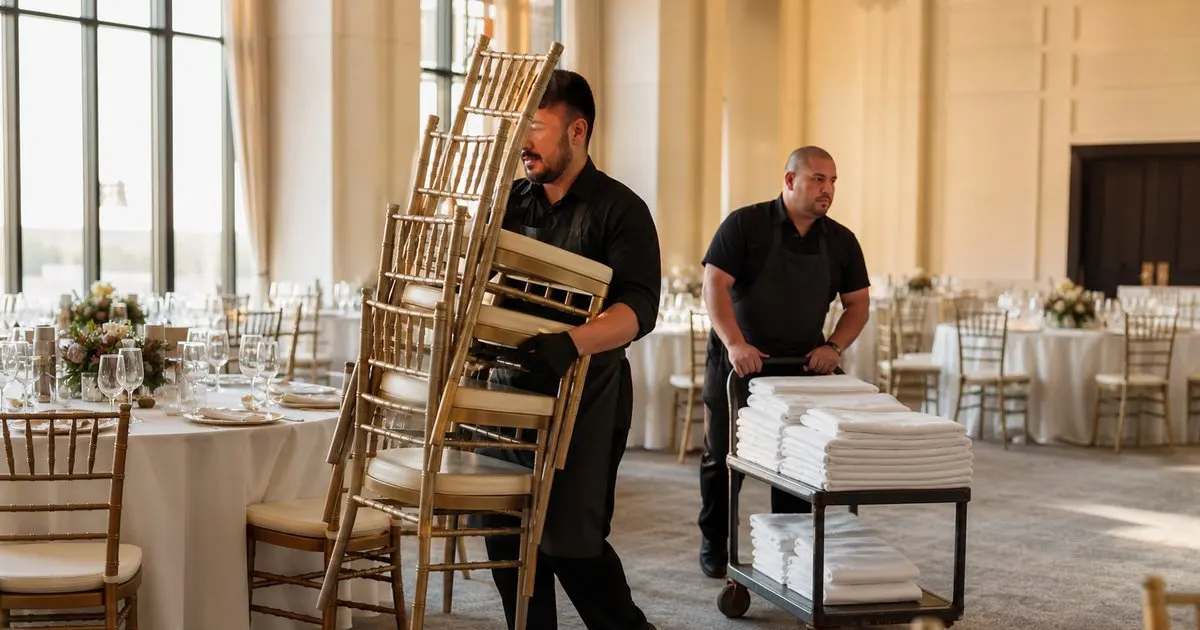
On most timelines we see, the room flip is invisible. The ceremony ends at 5:00, dinner is called at 6:30, and the ninety minutes in between are labeled cocktail hour. Nobody wrote down that in those ninety minutes a venue team has to clear a hundred and fifty ceremony chairs, roll in twenty rounds, dress every table, set place cards, move the band gear from the corner to the stage, and re-focus the lighting. That work is a production sequence with its own dependencies, and when it lives in a gap instead of a block, no one owns it and no one is watching the clock on it. Related: How can a planner share the event day timeline with every vendor so nobody works from an old version?
Give the flip a line on the run of show the same way you give the toasts a line. Write a start time, an end time, a room, and an owner. The start is not when the ceremony ends, it is when the last guest actually clears the space, which is usually several minutes later than the program says. The end is not when the tables are set, it is when the room is guest ready: linens straight, candles lit, sound checked, doors able to open. Once the flip is a block, it competes for minutes honestly with everything else on the timeline instead of quietly stealing them. Related: How do event planners build a minute-by-minute run of show that actually keeps the day on schedule?
Keep reading: How do event planners build a minute-by-minute run of show that actually keeps the day on schedule?, How can a planner share the event day timeline with every vendor so nobody works from an old version?, What is the best way to adjust an event timeline on the fly when the day is running late?. See how GigTimelinr helps you event day-of run-of-show timeline builder.
Time It From Room Empty to Doors Open, Not From Program to Program
The only useful measurement of a flip is the span between two physical facts: the room is empty of guests, and the doors are ready to open. Ask the venue and the catering captain for their honest number for a room of your size and setup, then ask what that number assumes about staffing. A turnover quote is always a staffing quote in disguise. The same ballroom might flip in a typical thirty to forty five minutes with a full banquet team on the floor and take twice that if half the staff is still running the cocktail bar in the next room.
Then walk the sequence backward and look for the dependencies that block everything else. Chairs usually cannot come in until the ceremony seating goes out, and the ceremony seating cannot go out until the aisle runner and floral installs are cleared, and the florist may be the person who has to move those installs to the reception room. If one vendor is a chokepoint in three steps, that vendor sets your flip time, not the venue's general estimate. Write the chokepoint steps as their own short lines with owners, and you will spot the collision on paper weeks before it happens on the floor. Related: Why should every moment in an event run of show have a clearly assigned owner responsible for it?
Give Guests a Real Place to Be While the Room Changes
Guests do not experience a flip as production work. They experience it as being asked to stand somewhere. If the holding space is a narrow corridor with one bar and no seating, the flip feels twice as long as it is, and people start drifting back toward the closed doors and asking staff when dinner is. Plan the holding space with the same care as the program: enough bar stations for the headcount, some seating for older guests, passed food starting within the first ten minutes, and a reason for people to stay put, whether that is a photo moment, a musician, or a view.
The timeline should carry the guest side of the flip in parallel with the production side. Put a line for bars open, a line for passed appetizers, a line for any guest activity, and a line for the soft cue that starts moving people back. Cocktail hour is the guest label, but underneath it there are three or four timed things happening, and each of them belongs to someone. When the flip runs long, that parallel track is also your lever: another round of passed food and a second announcement buys you ten minutes far more gracefully than opening the doors into a half dressed room. Related: What details and cues should a run of show include beyond just the times for each event moment?
Name the Person Who Calls the Room Ready
Every flip needs one person with the authority to say the room is open. It is usually the venue banquet captain or the lead coordinator, and whoever it is should be named on the run of show next to the flip block. That person does a final walk with a short checklist in their head: linens and place settings, centerpieces and candles, head table, cake table, gift and card table, sound check done, house lights at reception level, doors staffed, nothing left in the room that belongs to the ceremony. Without a single caller you get the classic failure, which is two people each assuming the other opened the doors.
Write the cue chain too, because the flip does not end when the room is ready, it ends when guests are inside and seated. That is typically a sequence: the caller confirms ready, the coordinator signals the band or DJ, the DJ makes the announcement, staff open the doors, and the room fills over the next several minutes before any welcome or first dance. Build a small cushion between doors open and the first program moment, usually five to ten minutes for a seated dinner crowd, because the seating shuffle always takes longer than it looks. If the flip finishes early, that cushion absorbs it. If it finishes late, you know exactly which downstream lines to compress.
- Put the flip on the timeline as its own block with a start, an end, and a named owner, never as unlabeled space inside cocktail hour.
- Measure the flip from room empty to doors ready, and treat any vendor who blocks three other steps as the real constraint.
- Plan the guest holding space and its own timed lines, so a long flip reads as a good cocktail hour rather than a delay.
- Name one person who calls the room ready, write the cue chain after that call, and leave a short cushion before the first program moment.

Julien Jimenez
Julien Jimenez is an independent software builder based in Paris. He designs, ships, and operates focused SaaS products for small businesses and independent professionals. Read the full author page.
A run of show that holds
Event day-of run-of-show timeline builder. GigTimelinr is built to help you put this into practice.
Build your run of showMore from the GigTimelinr blog

Get the GigTimelinr playbook
Practical guides on event production, straight to your inbox as we publish them. No spam, unsubscribe any time.