What should an outdoor event run of show include for a weather call and a rain plan?
A rain plan that lives in a separate document is a plan nobody will find at 2:00 pm with clouds building. Here is how to write the weather call and the alternate sequence into the timeline itself.
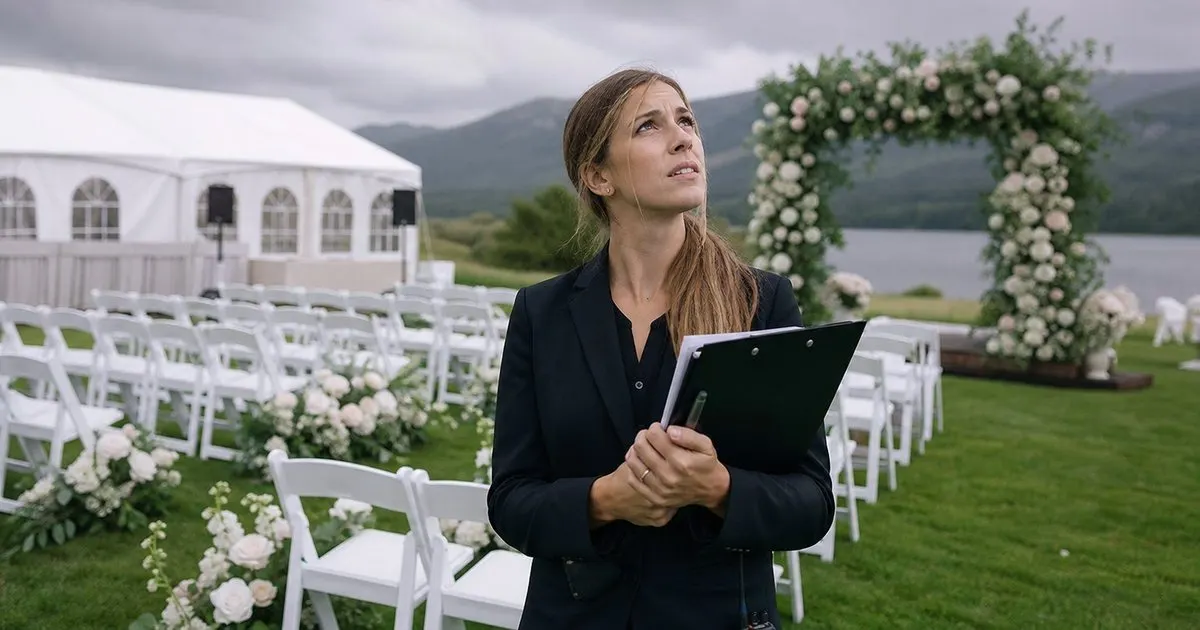
The weather call is a timeline line, not a feeling
The single most important decision on an outdoor event day is often made badly, because it is made late and by committee. A client watching the sky at 3:30 for a 4:00 ceremony is not making a decision; they are hoping. The run of show should instead contain a specific line: 'Weather call, 12:00, decision by planner with client, based on forecast for 3:30 to 6:00'. That line has a time, an owner, and a criterion, which is what turns a hope into a call. Related: What is the best way to adjust an event timeline on the fly when the day is running late?
Set the call time by working backward from what the alternate plan requires. If moving the ceremony indoors means the rental crew needs two hours to reset chairs and the florist needs an hour to relocate the arch, the call has to happen at least three hours before the ceremony, plus margin. Ask each affected vendor how long their part of the switch takes, add those up along the critical path, and that sum tells you the latest possible call time.
Keep reading: How do event planners build a minute-by-minute run of show that actually keeps the day on schedule?, How can a planner share the event day timeline with every vendor so nobody works from an old version?, What is the best way to adjust an event timeline on the fly when the day is running late?. See how GigTimelinr helps you event day-of run-of-show timeline builder.
Writing Plan B as a parallel sequence, not a footnote
A note that says 'if rain, ceremony moves to the pavilion' is not a plan. It leaves every vendor to guess what changes for them. The useful version is a second sequence for every block that differs: where guests are held, how they get to the alternate space, where the ceremony musicians set up and whether they need power there, where the photographer shoots portraits, and how the cocktail hour changes if the terrace is unusable. Each of those has a time, an owner, and often a different duration than the fair-weather version.
The practical way to do this is to draft the Plan A timeline, then copy it and edit the copy into Plan B, keeping every line that does not change and rewriting the ones that do. Share both with every vendor before the event, clearly labeled, so the weather call becomes a one-line message: 'We are on Plan B'. Vendors who have already read Plan B can act immediately; vendors who are hearing it for the first time will call you with questions during the hour you can least afford them. Related: How can a planner share the event day timeline with every vendor so nobody works from an old version?
Tents, heat, wind, and the weather that is not rain
Rain gets the attention, but in our experience outdoor events run into trouble at least as often from heat, wind, and cold. A ceremony in full sun at the hottest hour needs shade, water stations, and shorter durations, all of which belong on the timeline. Wind above a certain point makes tents dangerous and knocks over florals and ceremony structures, and the tent vendor will have their own threshold at which they will not allow the tent to be occupied. Write that threshold and who monitors it into the run of show. Related: Why should every moment in an event run of show have a clearly assigned owner responsible for it?
A tent is not automatically a rain plan either. A tent with no sidewalls in a driving rain, or with no heat when the evening temperature drops, is a wet, cold room. If the tent is the Plan B, the run of show should include the sidewall and heater deployment as lines with times and owners, since installing sidewalls on a large tent is not a five-minute task. The same is true for lighting: an outdoor evening plan that moves under a tent often needs different lighting than the open-air plan.
The mid-event switch and communicating it to guests
The hardest version of the weather problem is the one where conditions turn after the event has started. The run of show should identify the last practical point at which each block can still move: after which the ceremony cannot relocate, after which dinner cannot move indoors without disrupting service. Beyond those points the plan becomes shelter and pause, not relocation, and the timeline should say what pausing looks like, including where guests go and who addresses them. Related: How do event planners build a minute-by-minute run of show that actually keeps the day on schedule?
Guest communication is the part planners most often forget to script. Decide in advance who makes the announcement, what they say, and in what order groups move so the doorway does not jam. An MC or officiant with two prepared sentences and a clear direction moves a room calmly; a planner shouting over rain does not. Write the announcement owner and the wording into the timeline next to the switch cue, so the words are ready before the clouds are.
- Put the weather call on the timeline with a time, an owner, and a criterion, and set the time by adding up the switch time along the critical path.
- Draft Plan B as a full parallel sequence, share it labeled and early, and switch with a single message.
- Plan for heat, wind, and cold as well as rain, and write tent sidewall, heater, and lighting deployment as owned lines.
- Script the mid-event switch, including the last point each block can still move and who tells guests what.

Julien Jimenez
Julien Jimenez is an independent software builder based in Paris. He designs, ships, and operates focused SaaS products for small businesses and independent professionals. Read the full author page.
A run of show that holds
Event day-of run-of-show timeline builder. GigTimelinr is built to help you put this into practice.
Build your run of showMore from the GigTimelinr blog

Get the GigTimelinr playbook
Practical guides on event production, straight to your inbox as we publish them. No spam, unsubscribe any time.